AHA Action Hour: Why Housing Reform Matters

Authors: Gillian Gingher, RA
Editors: Charlotte Dhaya, Darby Fly
Atlanta is synonymous with civil rights, traffic, and, lately, lack of affordability.
With the top 20% of residents earning, on average, over $350,000, and the bottom 20% of residents earning, on average, $11,000 in 2024, Atlanta has officially solidified itself as the US city with the highest income inequality for multiple years in a row (GOBanking Rates). The average required annual income needed to buy a home for the median price of $369,400 in the Atlanta Metro Area was $114,301 in Q1 of 2025 (State of The Nation’s Housing 2025, Joint Center For Housing Studies Harvard University).
The reasons behind Atlanta's complex relationship with inequality are multi-faceted, but this blog will focus on the large role that land use and zoning play in exacerbating existing inequities.
In February, KUA hosted Abundant Housing Atlanta’s (AHA) first Action Hour focused on the upcoming zoning rewrite being put forward by the City and the impact those changes will have on our communities. This blog is a summary of our discussion in partnership with AHA.
ATLANTA'S ZONING 2.0 REWRITE + THE FUTURE OF HOUSING ATTAINABILITY
2026 marks the culmination of a multi-year effort to rewrite the City of Atlanta’s official zoning ordinance, a document largely unchanged since 1980. The contributions of city officials, consultants, and engaged citizens to this process are commendable.
However, as it currently stands, the rewrite has a significant gap at the center of its policy framework: meaningful housing reform.
The housing crisis has become one of the most pressing issues in the United States. From the Oval Office to the kitchen table, Americans across the political spectrum are increasingly concerned about housing affordability. As an architecture firm dedicated to creating flourishing neighborhoods, this issue is central to KUA’s work. Housing attainability is a foundational ingredient in healthy communities.
At the heart of the conversation are a few simple questions.
Should the people who serve our communities—teachers, firefighters, nurses, and service workers—be able to afford to live in the places they support?
Should seniors be able to downsize in the same neighborhoods they helped build?
Should young adults have a realistic chance of owning a home before the age of 40, now the median age of a first-time homebuyer in the United States (National Association of Realtors)?
Should more of our daily trips be possible on foot or by bike rather than by car?
We believe the answer to all of these questions is “yes!”
Achieving these outcomes requires the alignment of many puzzle pieces. In our professional experience, the largest and most correctable barrier to housing policy progress is zoning reform.
Zoning policy shapes how cities grow, what kinds of housing can be built, and where jobs and educational opportunities are allowed to thrive.
Historically, zoning has also been used as a tool of segregation, displacement, and exclusion.
For that reason, zoning reform is not only a practical issue, it is also a moral one. Updating these policies is not simply about increasing housing supply, it is about correcting long-standing inequities and creating communities where more people can participate in the life of the city.
In other words, housing reform is a pathway to housing justice.
Creating attainable housing for middle- to low-income community members—including seniors, civic workers, Millennials, and Gen Z—ultimately benefits everyone. Flourishing neighborhoods depend on people of different ages, incomes, and backgrounds being able to live side by side. That vision is why this work matters and why this conversation is so important.
THE HOUSING MISMATCH
Let’s take a step back and frame the conversation about Zoning 2.0 in the context of the nation’s housing needs.
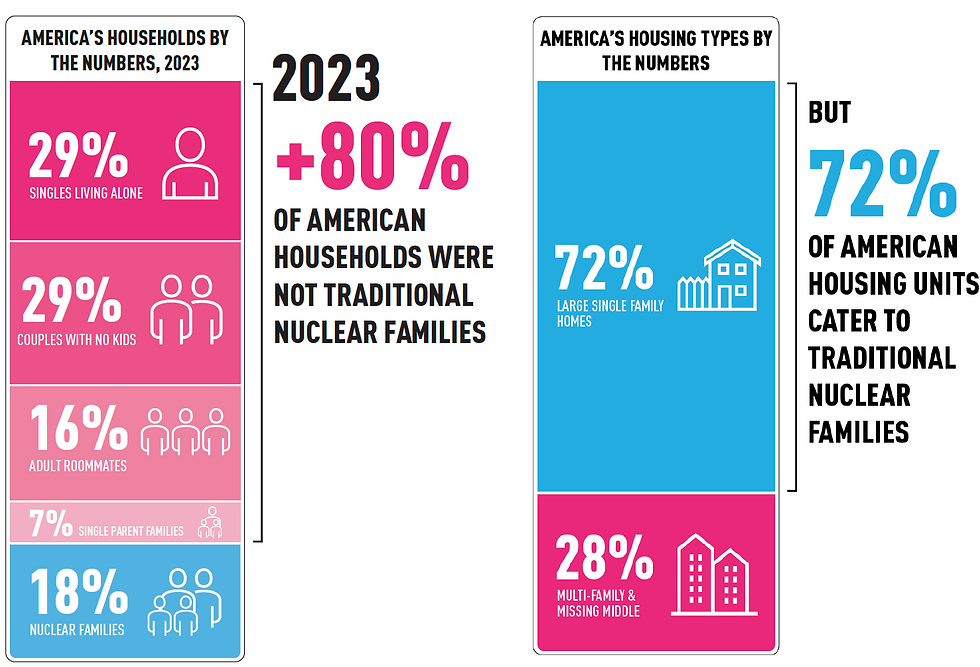
Today, more than 80% of American households are not traditional nuclear families (AARP, Make Room for Making Room). Instead, households increasingly consist of people living alone, couples without children, roommates, and single parents (AARP, The ABCs of ADUs).
Mid-century housing reflected a very different reality. In the 1950s, the average household had nearly four people (AARP, The ABCs of ADUs). Homes were also much smaller, averaging less than 1,000 square feet (AARP, The ABCs of ADUs). That worked out to roughly 300 square feet per person. In the 1960’s nearly 44% of households were nuclear families (Visual Capitalist. “Over Half of Households in the U.S. Don’t Have Kids.” Voronoi. November 3, 2024.)

Over time, homes have grown significantly larger. This trend is often attributed to builder greed, but the reality is more complicated. Builders respond to the regulatory environment that shapes the market. When zoning regulations allow only one house per lot, the financial incentive becomes clear: build the largest house possible. Larger homes help cover the fixed cost of land and maximize the value of the single unit allowed.
Zoning rules influence the type of housing that gets built.
At the same time, the number of people living in each household has steadily declined. In Atlanta, the average household size in 2023 was just over two people. As household sizes shrink, the number of housing units required to support the same population increases dramatically.
Our households have changed dramatically and our housing supply has not kept up.
In the 1950s, two houses could comfortably accommodate eight people. By 2017, with an average household size of about 2.5 people, it took three houses to accommodate that same number. At today’s average household size in Atlanta, it takes roughly four houses to house those eight people: that’s twice the number of homes for the same number of people!
Yet the types of homes allowed by current zoning laws can not adapt to this shift. Smaller homes and smaller lots are rarely permitted in many neighborhoods. Instead, the regulatory framework continues to push development toward larger homes designed for mid-century nuclear family lifestyles.
At the same time, we are building fewer small homes than ever before. In the 1970s, about 40% of new homes were smaller than 1,400 square feet. By 2020, that number had dropped to roughly 8%.
This matters because smaller homes naturally provide more attainable price points. When fewer of them are built, the number of attainable housing options fails to meet the demand.
The result is a clear mismatch. Only a small share of households today are nuclear families, yet a large portion of our housing stock consists of large single-family homes designed for exactly that household type.
Our households have changed. Our zoning rules have not.
LEARNING FROM ATLANTA'S PAST
Atlanta was not always built this way.
When the city adopted its first comprehensive zoning map in 1929, land use patterns were closely aligned with the city’s trolley network. Higher density development clustered along transit routes and around key urban destinations. Many of Atlanta’s most walkable neighborhoods today still fall within that original 1929 boundary.

Equally important during the same period is what types of housing the zoning code allowed. Residential districts commonly permitted a range of housing types, including houses, duplexes, accessory dwelling units, and home occupations. Small professional offices operating from residences were a normal part of neighborhood life.
The history of Atlanta’s population also provides important context. The city reached nearly 500,000 residents in the 1970s and has slightly more than 520,000 people living within city limits today. At first glance, that suggests modest growth.
But, as discussed, household sizes have shrunk dramatically since mid-century. As a result, Atlanta now needs far more housing units to accommodate a similar population.
Density trends illustrate this shift. In 1940, Atlanta had roughly 8,500 people per square mile. By 2024, that number had dropped to about 3,800 people per square mile, though it has begun to increase again in recent decades (atlcitydesign.com/blog/2021/2/10/thread-atl-blog-post).

Today, however, many of Atlanta’s most transit rich areas remain locked into exclusive single family zoning. When these areas are mapped alongside MARTA stations and the BeltLine corridor, a troubling pattern emerges.
Places with the best access to resources often allow the fewest housing options.

Limiting housing choices in areas with the best access to transit, jobs, and infrastructure restricts the number of people who can live in those communities.
Housing scarcity results in higher housing prices, resulting in more people living further away from resources.
This reinforces patterns of exclusion that have shaped land use policy for generations.
To dive deeper into this topic, see our “Re-Regulating for Abundance” presentation here.
ATLANTA + IT'S PEER CITIES
Housing reform has become a national policy priority. In response to the growing housing crisis, the National Housing Crisis Task Force developed a set of recommendations to help cities address housing shortages. One of the co-chairs of that task force may look familiar: Atlanta’s own mayor, Andre Dickens.
The Task Force’s recommendations are straightforward and widely supported by housing economists and urban policy experts.
Cities should allow more homes per lot.
Cities should permit larger and more flexible accessory dwelling units.
Cities should allow smaller lot sizes and enable lot splits that create more opportunities for home ownership.
Parking minimums should be removed where possible.
Cities should stop regulating narrow definitions of what constitutes a household.
Housing should be allowed in greater quantities near transit infrastructure.
Atlanta is not alone in facing a housing shortage, but other cities have already begun adjusting their zoning policies to respond.
Charlotte, Raleigh, and Durham provide useful comparisons because they compete with Atlanta for corporate headquarters, jobs, and talent. These cities have also adopted more flexible land use policies in recent years.
Charlotte now allows duplexes and triplexes in most residential districts. Raleigh and Durham have expanded zoning to allow a wider range of housing types across much of their residential land. Both Charlotte and Durham have also reduced or eliminated parking minimums in many areas. These policy changes have had measurable effects.

Charlotte, Raleigh, and Durham have added housing at significantly faster rates than Atlanta in recent years. While Atlanta’s housing stock grew by roughly 9% over a comparable period, these peer cities increased their housing supply closer to 16%.
In 2021, when discussion about updating Atlanta’s zoning was kicking off, Joshua Humphries, the city’s director of housing and community development, estimated “... around 11,500 new housing units would be created if 15 percent of current single-family properties added an ADU” (Atlanta Civic Circle). So why has the draft reforms not been written to reflect this?
More housing supply creates more options in the market.
Cities that build more housing tend to have higher vacancy rates, which means more availability and more flexibility for renters and buyers.
And when supply increases, prices respond. Per KUA’s research, average rents in these cities are often 10% to 15% lower than in Atlanta.
The lesson is straightforward: cities that allow more housing tend to be more affordable.
THE OPPORTUNITY IN ZONING 2.0
There is no denying that it is time to re-write Atlanta’s zoning. Zoning reform has the opportunity to address so many concerns, inequities, educational disparities, affordability, and more.
Across the country, housing policy experts increasingly agree on the types of reforms that help address housing shortages; reforms that are in-line with the recommendations of the National Housing Task Force.
These are not radical ideas. In fact, they have become widely accepted best practices for addressing housing shortages.
Which raises an important question: How many of these recommendations appear in Atlanta’s proposed Zoning 2.0 update? Unfortunately, the answer is disappointing:
Many of these reforms appear only minimally in Atlanta’s proposed Zoning 2.0 update. Instead of simplifying the code and expanding housing opportunities, the Zoning 2.0 proposal risks introducing new layers of complexity and micro regulation.
Despite the growing body of national research linking zoning restrictions to housing affordability, Atlanta’s zoning leadership has at times suggested that zoning has little connection to housing costs. That position is increasingly difficult to defend given the experience of cities across the country.
Even more concerning, the proposed zoning rewrite introduces a proliferation of highly detailed regulations and micro-level controls that add complexity rather than flexibility. Rather than simplifying the code or expanding housing opportunities, it risks creating a regulatory environment many have aptly described as “death by a thousand cuts.”
For example, the proposal includes a new provision that micromanages lot coverage within a side yard setback when it is impacted by a driveway, on top of existing overall lot coverage limits. This adds another layer of calculation for designers to demonstrate compliance, and for plan reviewers to verify it, ultimately slowing down the process without delivering clear public benefit.
Another example: Earlier in this post we discussed household size. Currently, Atlanta’s zoning code allows for 6 unrelated individuals to live together (such as 6 students living together for their senior year of college at Morehouse). Zoning 2.0 will change that number to 3 unrelated individuals. Not only will this make the house of 6 students illegal, but it will make finding legal, affordable, rental housing much more difficult because the housing that does meet this requirement will be in much higher demand.
Atlanta’s mayor has set an ambitious goal of creating 20,000 units of affordable housing. It is a goal worth supporting.
But the current version of Zoning 2.0 will not get us there.
If Atlanta is serious about addressing its housing shortage, the zoning update must reflect policies that have proven effective elsewhere. That means allowing more housing types, reducing unnecessary barriers, and aligning land use policy with the city’s housing goals.
Atlanta can still get this right. The question now is whether we are willing to take the steps necessary to do so.

Is there a larger role for more diverse types of home ownership including multifamily condominiums, co-ops and community land trusts? Those would seem to fit well within transit-rich corridors. Then there is all the public rental housing we have not built since the late 1990s.